How to Stop Overbuying Groceries: 6 Simple Habits
The way to stop overbuying groceries is to decide what you need before you reach the store. Check what you already have, pick your meals, write a list with amounts for each shop, and set a low level for your staples so "do we need more?" has a real answer. Then give yourself a rule for bulk packs and deals, and eat something before you go.
The short version: look in the fridge, freezer and pantry first. Choose meals, then write the list. Group it by shop and write amounts. Rebuy a staple only when it reaches its low level. Take a deal only if the item was already on your list, or you can name when you'll use the extra. Have a snack before you leave.
Why people overbuy groceries
Overbuying rarely feels like a mistake at the time. It's what tends to happen when a shopping trip runs on memory and whatever is on display.
| What happens | What fixes it |
|---|---|
| You can't remember what's at home | Check before you shop |
| Food has no meal attached to it | Plan meals first |
| The list says "salad", not how much | Write amounts, by shop |
| "We're probably low" | Set low-stock levels |
| The deal looks too good to skip | Use a rule for deals |
| You shop on an empty stomach | Eat first |
It adds up. The USDA's Economic Research Service estimated consumer-level food loss at about 21 percent of the available food in 2010. Overbuying is only part of that number, which also counts things like cooking loss and plate waste. The EPA says the average family of four spends almost $3,000 a year on food that doesn't get eaten.
This post is about the shopping side. For storage, leftovers and everything after the store, see our 12 habits to reduce food waste at home.
1. Check what you have before you shop
The EPA's advice is direct: "Look in your refrigerator, freezer, and pantry first to avoid buying food you already have."
You don't need a full count for this. Two minutes is enough if you check the things you buy on autopilot, since those are the ones that pile up: milk, eggs, onions, pasta sauce, bread, snacks. Open the freezer too, because it's the easiest place to forget.
A check at home doesn't help when you're in the aisle wondering about cumin, though. That's the case for keeping a list you can read away from the kitchen. Our guide to keeping track of food at home walks through the setup, and there's a free pantry inventory template if you prefer paper.
2. Pick the meals first, then write the list
Shopping from meals changes the question from "does this look good?" to "what is this for?" Give every fresh item a job. If you can't name the meal, it stays on the shelf. Staples are the exception, and the next habits cover those.
Keep the plan small and honest:
- Count the dinners you'll really cook. The EPA suggests basing your list on how many meals you'll eat at home, allowing for nights out, frozen meals and leftovers.
- Keep a short list of meals your household already likes. The EPA recommends this too, because food you're likely to eat is food you'll finish.
- Make one meal a week from what's already there. In two randomized field studies, Canadian and US families with children were asked to make one meal a week from food that might otherwise be thrown out. They reported wasting 27 percent (Canada) and 33 percent (US) less than control groups. Waste was self-reported, Unilever funded the research, and eight weeks later the gap with the control groups was no longer significant. It's still a low-effort habit to try, and that meal is one less to buy for.
Don't expect a meal plan to do all the work alone. A survey of 244 consumers in Romania found planning and shopping routines to be important predictors of food waste, but ReFED's 2026 survey report notes that earlier research on meal planning by itself is mixed, and that it may depend on habits like using leftovers and storing food well.
3. Write a list for each shop, with amounts
One long list falls apart once you shop in more than one place. You buy the tomatoes at the supermarket because you're there, then buy the big pack at the warehouse store on Saturday because that's where you always get them.
A list per shop fixes that. Each item gets one home, so it can only be bought once. A simple split might be:
- Weekly supermarket: milk, eggs, fresh produce, bread.
- Warehouse or bulk store: canned tomatoes, rice, coffee.
- Local market: whatever fresh food you'll use in a day or two.
Then add amounts. The EPA recommends including quantities and noting how many meals each item will make, specifically to avoid overbuying. "Spinach, enough for two lunches" gets you a small bag. "Spinach" gets you whatever is at eye level.
4. Use low-stock levels instead of guessing
Overbuying often starts with one vague thought: we might be low on that. Buying "just in case" feels safe, so the rice and canned beans quietly multiply.
A low-stock level removes the guess. Pick the amount at which you rebuy an item, and until it gets there, you don't buy it, however good the display looks. Low points are usually pitched as a way to avoid running out. They work just as well in the other direction.
To set a level, think about how much you use between shops:
- Estimate your use. Say you go through two cans of tomatoes between shops.
- Set the level to cover that. A low level of 2 means you won't run out before the next trip.
- Decide how many to buy. Restock to a number you'll get through in a few weeks, not as many as the shelf holds.
- Adjust. Ran out? Raise the level. Cans still piling up? Lower it.
Use this for staples, not fresh food. Fresh food should come from your meals. Our pantry staples list is a good place to choose which items deserve a level.
5. Give bulk packs and deals a rule
You have plenty of company here. In the ReFED and YouGov survey of 1,000 US households in January 2026, 632 said their grocery spending had changed because of food prices. Of those, 84 percent were looking for sales and deals more often, and 61 percent were buying larger or bulk packages to cut the per-unit price.
Does that lead to waste? The research is honestly mixed:
- A field experiment in eight Swedish supermarkets found that a two-item bundle price sold 19.5 percent more units than a single-unit discount at the same price per item. In a small follow-up survey, 12 percent of multi-unit buyers said they didn't eat it all, against 0 percent of the others, a gap the authors note wasn't statistically significant.
- A 2023 study in the Journal of Consumer Research found that households who bought more than usual on a multi-unit deal reported wasting less than those paying regular prices, and also reported eating and freezing more.
Taken together, deals can get you to buy more, and whether that becomes waste seems to depend on what you do with the extra. As the EPA puts it, buying in large quantities "only saves money if you use all the food before it spoils." So ask three questions at the display:
- Was it on my list, or is it something I always use? If not, the deal isn't saving you anything.
- When will I finish it? Check our food expiration dates chart if you're unsure how long it keeps.
- Where will the extra go? If the answer is the freezer, note it on your freezer inventory so it doesn't vanish in there.
If you have a good answer to all three, take the deal. If you want a small amount of something, bulk bins are a good alternative: the EPA says they can save money and cut waste as long as you buy only what you need.
6. Eat before you shop
"Never shop hungry" is common advice, and the evidence behind it is thinner than you might expect. A widely quoted 2013 study on hungry grocery shoppers was retracted in 2018 because its results couldn't be confirmed.
Two other studies are narrower:
- In a virtual supermarket study of 94 students, the most impulsive participants bought the most calories, especially from snack food, but only when they felt hungry.
- In a study of 81 department store shoppers, those who said they were hungrier bought more and spent more on nonfood items. Hunger was self-reported and almost nobody bought food, so it doesn't show what happens in a grocery aisle.
So hunger probably matters more for some people, and for snacks and impulse buys more than for the weekly basics. A banana before you leave costs almost nothing, though, and it makes the list easier to stick to.
Start with two habits and add more
You don't need all six at once. The ReFED survey tied reported waste reduction to several behaviors together rather than any single change. Each additional behavior went with about an 8 to 11 percent higher probability of reporting less waste, depending on whether a household's grocery spending had risen or fallen. That's self-reported and doesn't prove cause and effect, but it suggests habits add up.
A good first pair is the check before you shop and amounts on your list. Add low levels once you know what you keep buying twice.
How to do this in Panzy
Panzy is a pantry inventory app for iPhone, and it's built for exactly the two questions behind overbuying: what do we have, and what do we really need? Your stock and your list are on your phone, so you can settle "do we have cumin?" from the aisle.
- Add what you buy regularly. Scan a barcode to fill in the product details, then set the quantity and where it lives.
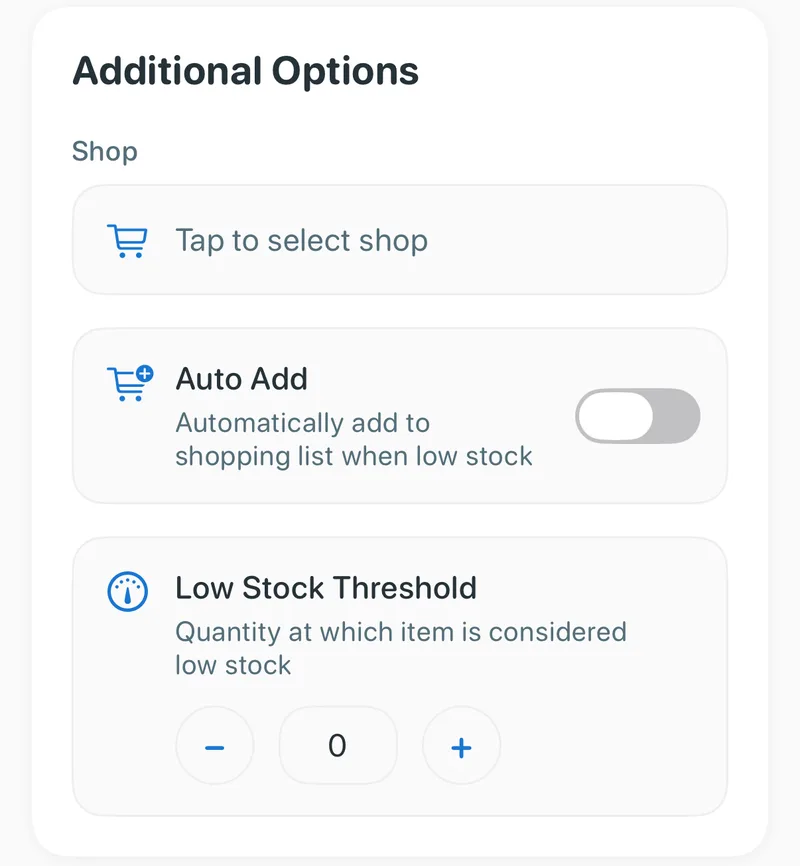
- Set a low-stock level on each item. Every item has its own Low Stock Threshold, so eggs and rice can follow different rules. When an item reaches its level, Panzy flags it as low stock. The Pantry tab counts your low items, and tapping the card lists them.
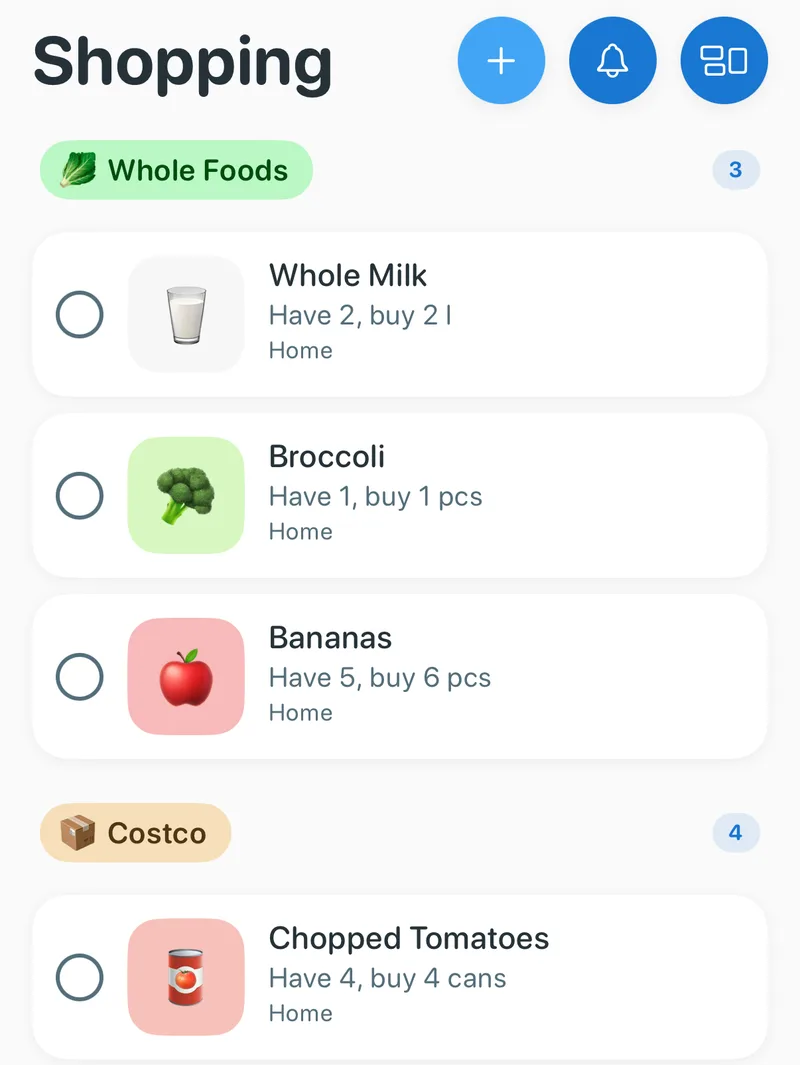
- Save your shops and group the list by shop. Set a shop on an item or a list entry, then group the shopping list by shop. Each shop becomes its own section, and items linked to your pantry show how many you have next to how many to buy.
- Let low items fill the list. With Panzy+, turn on Auto Add for an item and it goes onto your shopping list when it runs low. On the free plan, the low-stock flag still tells you what to add yourself.
The free version covers up to 50 items and 3 shops, with ads, which is plenty for the staples you tend to double-buy. Panzy+ adds unlimited items and shops, the automatic shopping list, expiration reminders, iCloud sync across your Apple devices, and no ads.
Panzy: pantry tracker
Track what's in your pantry, fridge and freezer, see what is expiring soon, and keep a shopping list that knows what you're low on. Free for up to 50 items.

Common questions
Why do I keep overbuying groceries?
Often because the decision happens in the store, based on memory and what's on display. Checking what you have and writing a list with amounts moves the decision back home, where you have better information.
How do I stop overbuying food when I live alone?
Buy for the meals you'll really cook, and expect fewer than you think. The USDA's Economic Research Service notes that smaller households that eat out more may also have more waste. Choose smaller packs where you can, use bulk bins for small amounts, and freeze part of what only comes in large sizes.
Is buying in bulk a bad idea?
Not if you finish what you buy. Shelf-stable staples you use often are the safest choices. Big packs of fresh food are the riskiest, unless you have a plan to freeze or cook the extra.
Does shopping hungry really make you buy more?
The evidence is limited and comes from small studies. It suggests the effect is strongest for impulsive shoppers and for snack food. Eating first is still an easy habit to keep, since it costs almost nothing.