Food Expiration Dates Chart: How Long Food Lasts in the Pantry, Fridge and Freezer
Most fresh food lasts days in the fridge, months in the freezer, and pantry staples last months to years. Raw ground meat, poultry and fish keep only 1 to 3 days in the fridge, steaks and chops 3 to 5 days, leftovers 3 to 4 days and eggs in the shell 3 to 5 weeks. Food kept frozen at 0°F (-18°C) stays safe; the freezer times below are about taste and texture.
The charts below give storage times for the foods most of us actually buy, sorted by category, so you can find yours fast on your phone.
The short version: keep the fridge at 40°F (4°C) or below and the freezer at 0°F (-18°C) or below. Eat leftovers within 3 to 4 days or freeze them. Cook or freeze raw ground meat and poultry within 1 to 2 days. Freezer times are for best quality only: food kept frozen at 0°F (-18°C) stays safe indefinitely. When food looks, smells or feels wrong, throw it out, whatever the chart says.
Where these times come from
Every time in this post comes from a US government source:
- Meat, poultry, fish, eggs and leftovers: the Cold Food Storage Chart on FoodSafety.gov, the federal food safety site run by HHS with the USDA, FDA and CDC.
- Dairy, produce and pantry staples: the USDA's FoodKeeper, developed by the USDA Food Safety and Inspection Service with Cornell University and the Food Marketing Institute. It covers over 650 foods and drinks, on the web and as an app for Apple and Android devices.
Where the FoodKeeper and the chart cover the same food, this post uses the chart. The one place a USDA page gives a different time is noted under leftovers.
These are not the dates on the package
A storage chart and a package date answer different questions. The date printed on the package is set by the maker, and in the US most of those dates ("best if used by", "use by", "sell by") are about quality, not safety. The chart tells you how long the food keeps once it is in your kitchen, counted from when you buy it, open it or cook it.
So use both. If the package date comes first, the food may simply be past its best. If the chart time runs out first (an opened jar of pasta sauce, a cooked chicken), the chart wins. For what each label really means, see our guide to best by vs use by vs sell by.
The FoodSafety.gov chart explains why the fridge times are short: they help keep food from spoiling or becoming dangerous to eat. The freezer times are different. The USDA's freezing guide says it plainly: "Food stored constantly at 0 °F will always be safe. Only the quality suffers with lengthy freezer storage."
Meat and poultry
Fridge at 40°F (4°C) or below, freezer at 0°F (-18°C) or below. Times for raw meat start when you bring it home.
| Food | Fridge | Freezer |
|---|---|---|
| Ground beef, turkey, chicken or pork (raw) | 1 to 2 days | 3 to 4 months |
| Steaks, chops, roasts (raw) | 3 to 5 days | 4 to 12 months |
| Whole chicken or turkey (raw) | 1 to 2 days | 1 year |
| Chicken or turkey pieces (raw) | 1 to 2 days | 9 months |
| Bacon | 1 week | 1 month |
| Raw sausage | 1 to 2 days | 1 to 2 months |
| Cooked sausage | 1 week | 1 to 2 months |
Deli meats, hot dogs and ham
| Food | Fridge | Freezer |
|---|---|---|
| Hot dogs, unopened | 2 weeks | 1 to 2 months |
| Hot dogs, opened | 1 week | 1 to 2 months |
| Lunch meat, unopened | 2 weeks | 1 to 2 months |
| Lunch meat, opened or deli sliced | 3 to 5 days | 1 to 2 months |
| Cooked ham, store-wrapped, sliced | 3 to 5 days | 1 to 2 months |
| Cooked ham, store-wrapped, whole | 1 week | 1 to 2 months |
Fish and seafood
| Food | Fridge | Freezer |
|---|---|---|
| Fatty fish (salmon, tuna, mackerel, catfish) | 1 to 3 days | 2 to 3 months |
| Lean fish (cod, flounder, haddock, halibut, sole) | 1 to 3 days | 6 to 8 months |
| Shrimp | 3 to 5 days | 6 to 18 months |
| Fresh crab meat or lobster | 2 to 4 days | 2 to 4 months |
| Shucked clams, mussels, oysters, scallops | 3 to 10 days | 3 to 4 months |
Eggs
| Food | Fridge | Freezer |
|---|---|---|
| Raw eggs in the shell | 3 to 5 weeks | Do not freeze in the shell |
| Raw egg whites and yolks | 2 to 4 days | 12 months (yolks freeze poorly) |
| Hard-cooked eggs | 1 week | Do not freeze |
| Liquid egg substitute, opened | 3 days | Do not freeze |
To freeze eggs, the chart says to beat the yolks and whites together first. The USDA's egg guide adds that refrigerated eggs should not be left out more than 2 hours, and hard-cooked eggs should go in the fridge within 2 hours of cooking.
Leftovers and cooked food
| Food | Fridge | Freezer |
|---|---|---|
| Cooked meat or poultry | 3 to 4 days | 2 to 6 months |
| Soups and stews | 3 to 4 days | 2 to 3 months |
| Pizza | 3 to 4 days | 1 to 2 months |
| Chicken nuggets or patties | 3 to 4 days | 1 to 3 months |
| Egg, chicken, tuna or macaroni salad | 3 to 4 days | Does not freeze well |
| Casseroles with eggs, baked | 3 to 4 days | 2 to 3 months |
| Pumpkin or pecan pie, baked | 3 to 4 days | 1 to 2 months |
The one place the sources differ: the USDA's leftovers guide gives a general 3 to 4 months in the freezer for leftovers, while the FoodSafety.gov chart above gives a time per food. Both agree on 3 to 4 days in the fridge, and the leftovers guide adds that frozen leftovers are safe indefinitely but lose moisture and flavor over time. The table uses the FoodSafety.gov chart.
The same guide says to refrigerate leftovers within 2 hours of cooking (1 hour if it is above 90°F, or 32°C), and to divide big batches into shallow containers so they cool quickly. Reheat leftovers to 165°F (74°C).
Dairy
These come from the FoodKeeper. Fridge times are from the day you buy the food unless the row says "opened".
| Food | Fridge | Freezer |
|---|---|---|
| Milk | Until the package date | 3 months |
| Butter | 1 to 2 months | 6 to 9 months |
| Hard cheese (cheddar, Swiss, block parmesan), unopened | 6 months | 6 months |
| Hard cheese, opened | 3 to 4 weeks | 6 months |
| Shredded cheese | 1 month | 3 to 4 months |
| Soft cheese (brie, goat) | 1 to 2 weeks | 6 months |
| Cream cheese | 2 weeks | Not listed |
| Cottage cheese | 2 weeks, 1 week once opened | Not listed |
| Yogurt | 1 to 2 weeks | 1 to 2 months |
| Sour cream | Until the package date | Not recommended |
| Heavy cream | 10 days | 3 to 4 months |
| Half and half | 3 to 4 days | 4 months |
For milk and sour cream, the FoodKeeper simply says to go by the package date. "Not listed" means the FoodKeeper gives no freezer time for that food.
Fruit and vegetables
Also from the FoodKeeper, counted from purchase. "Not listed" means it gives no time for that place.
| Food | Pantry or counter | Fridge |
|---|---|---|
| Apples | 3 weeks | 4 to 6 weeks |
| Bananas | Until ripe | 3 days (skin darkens) |
| Avocados | Until ripe | 3 to 4 days once ripe |
| Citrus (lemons, limes, oranges) | 10 days | 10 to 21 days |
| Grapes | 1 day | 1 week |
| Strawberries, raspberries | Not listed | 2 to 3 days |
| Blueberries | Not listed | 1 to 2 weeks |
| Tomatoes | Until ripe, then 7 days | Not listed |
| Potatoes | 1 to 2 months | 1 to 2 weeks |
| Onions | 1 month | 2 months |
| Garlic | 1 month (whole bulbs) | 3 to 14 days (cloves) |
| Carrots | Not listed | 2 to 3 weeks |
| Broccoli, cauliflower | Not listed | 3 to 5 days |
| Leaf lettuce, spinach | Not listed | 3 to 7 days |
| Lettuce, iceberg or romaine | Not listed | 1 to 2 weeks |
| Cucumbers | Not listed | 4 to 6 days |
| Peppers | Not listed | 4 to 14 days |
| Mushrooms | Not listed | 3 to 7 days |
Two notes from the FoodKeeper: the USDA recommends keeping tomatoes in the pantry because the fridge can affect their flavor, and the pantry is also its recommended spot for whole potatoes (it cites the United States Potato Board: refrigeration can make potatoes darken during cooking and taste unpleasantly sweet). The FoodKeeper has freezer times for most produce too, with conditions attached to some (its potato time is for cooked and mashed potatoes, its apple time for cooked apples), so look those up in the app before you freeze.
Pantry staples
Pantry staples are where the date on the package usually comes first. The FoodKeeper times run from purchase for unopened food and from the day you open it after that.
| Food | Unopened, pantry | After opening |
|---|---|---|
| White flour | 6 to 12 months | 6 to 8 months (1 year in the fridge) |
| Whole wheat flour | 3 to 6 months | 6 to 8 months in the fridge |
| White rice | 2 years | 1 year |
| Brown rice | 1 year | 1 year (6 months in the fridge) |
| Dry pasta | 2 years | 1 year |
| Dried beans | 1 to 2 years | 1 year |
| Sugar | Indefinitely | Best within 18 to 24 months |
| Honey | 2 years | Not listed |
| Olive or vegetable oil | 6 to 12 months | 3 to 5 months |
| Peanut butter | 6 to 24 months | 2 to 3 months |
| Ready-to-eat cereal | 6 to 12 months | 2 to 3 months |
| Oatmeal | 12 months | 6 to 12 months |
| Store-bought bread | 14 to 18 days | 2 to 3 weeks in the fridge |
| Canned meat, soup, beans, vegetables | 2 to 5 years | 3 to 4 days in the fridge |
| Canned fruit, juice, tomato soup | 12 to 18 months | 5 to 7 days in the fridge |
| Pasta sauce in a jar | 18 months | 4 days in the fridge |
| Ketchup | 1 year | 6 months in the fridge |
| Mayonnaise | 3 to 6 months | 2 months in the fridge |
For canned food, the FoodKeeper notes that cans stay safe well past their "use by" or "best by" date as long as they show no dents, rust or swelling. And according to the FoodKeeper, shelf-stable commercial ketchup, soy sauce and mayonnaise are safe at room temperature after opening; the "refrigerate after opening" label is there for quality, not safety.
If you are stocking a kitchen from scratch, our pantry staples list covers what to buy, and organizing your pantry by category makes it easy to see what is getting old.
How to use a food storage chart at home
A chart only helps if you know when the clock started. A few habits make that easy:
- Write the date on anything without one. Leftovers, opened jars and freezer bags get the day you cooked, opened or froze them.
- Work out the "eat by" date when you put food away. Ground beef bought Monday needs cooking or freezing by Wednesday. Chili cooked Sunday is good through Wednesday or Thursday.
- Freeze before the fridge time runs out, not after. The USDA advises freezing food you won't use quickly sooner rather than later, because food frozen at peak quality tastes better after thawing.
- Keep the oldest food in front. First in, first out works for the fridge, freezer and pantry alike.
- Check the freezer by date, not by memory. A freezer inventory with a "use by" column turns the freezer chart above into a list of what to cook next.
Track your own dates with Panzy
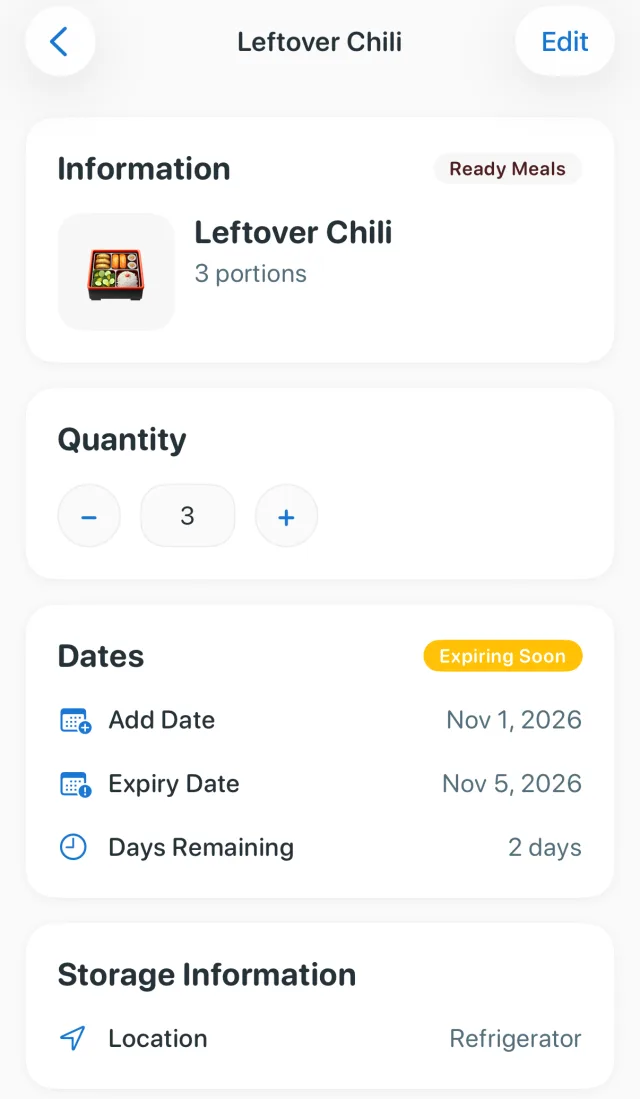
Panzy is a pantry inventory app for iPhone. Each item you add can have an expiry date, picked from a calendar, so you can enter the chart date for anything that doesn't have one printed, like leftovers or a pack of meat you just froze.
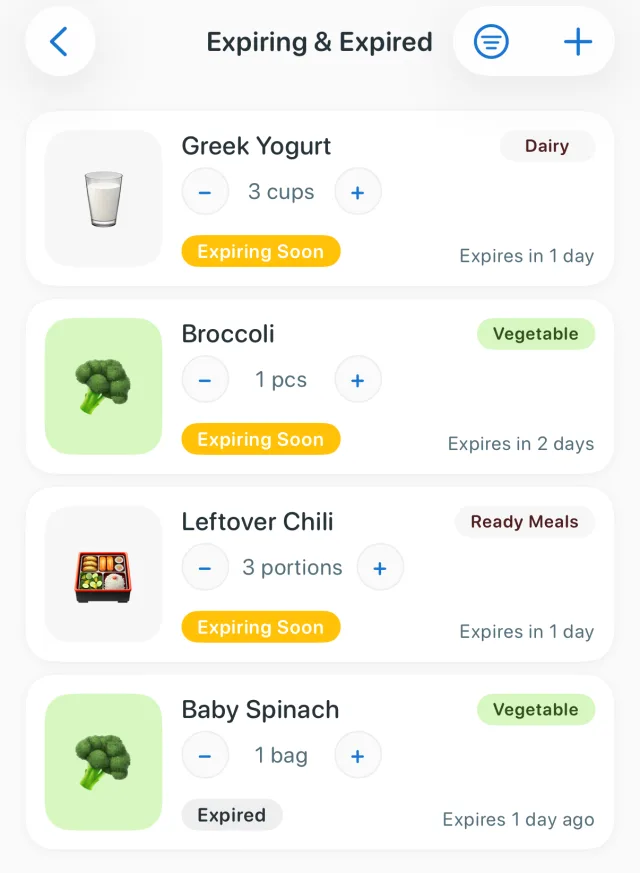
- Days remaining. Every item shows its add date, its expiry date and how many days are left.
- Expiring soon and expired. Items close to their date are labelled Expiring Soon, and items past it are labelled Expired. The Pantry tab counts them on an Expiring & Expired card, and one tap opens a list of just those items.
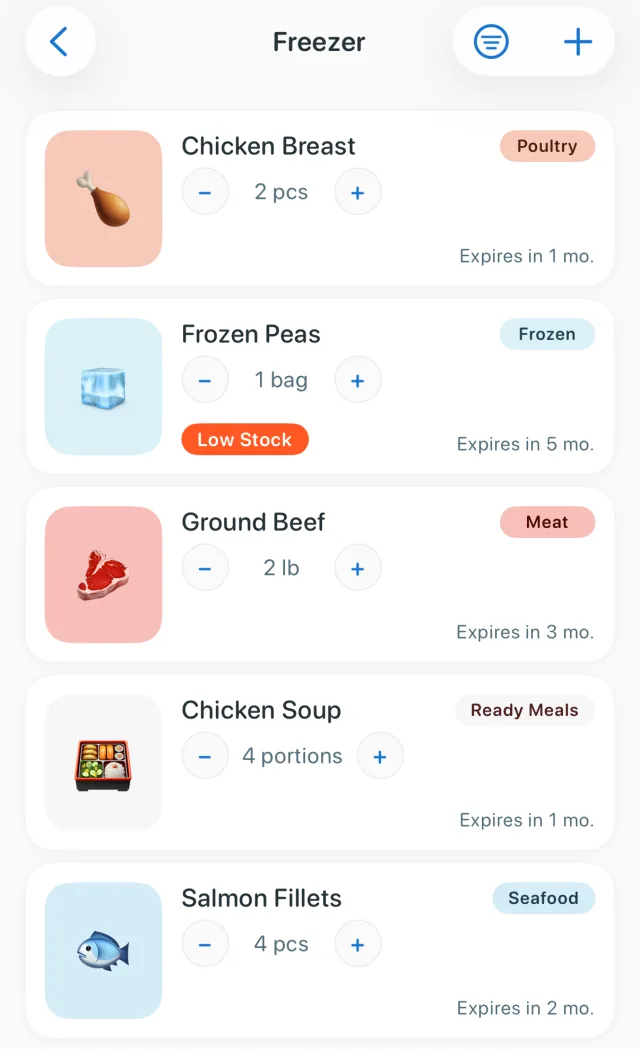
- Fridge, freezer and pantry. Each item has a storage location (Refrigerator, Freezer, Pantry and more), and each location opens as its own list.
- Reminders with Panzy+. With Panzy+, you can also turn on an expiry reminder for a notification a chosen number of days before the date. Reminders are not part of the free version.
The free version tracks up to 50 items. Panzy+ adds unlimited items, expiry reminders, the automatic shopping list, iCloud sync across your Apple devices, and no ads.
Panzy: pantry tracker
Track what's in your pantry, fridge and freezer, see what is expiring soon, and keep a shopping list that knows what you're low on. Free for up to 50 items.

Common questions
How long does food last in the fridge?
It depends on the food. Raw ground meat and poultry last 1 to 2 days, raw steaks and chops 3 to 5 days, fish 1 to 3 days, leftovers 3 to 4 days and eggs in the shell 3 to 5 weeks, according to the FoodSafety.gov cold food storage chart. Keep the fridge at 40°F (4°C) or below.
Is food safe after the freezer time on the chart?
Yes, if it stayed frozen at 0°F (-18°C) the whole time. The USDA says food stored constantly at 0°F will always be safe, and the chart times are for quality. Past them, food may be drier or less flavorful, so it works better in soups and stews.
How long are leftovers good for?
3 to 4 days in the fridge. The USDA says to refrigerate them within 2 hours of cooking and reheat them to 165°F (74°C). If you won't eat them in time, freeze them.
Do pantry foods expire?
Most pantry staples lose quality slowly rather than becoming unsafe. White rice and dry pasta keep about 2 years unopened according to the FoodKeeper, and sugar keeps indefinitely. Canned food stays safe past its date as long as the can has no dents, rust or swelling. Oils, peanut butter and whole wheat flour have the shortest times once opened, so check those first.
Where can I look up a food that is not on this chart?
The USDA's FoodKeeper covers over 650 foods and drinks, on the web and as an app.