Freezer Inventory: How to Know What's in Your Freezer
A freezer inventory is a list of everything in your freezer with two dates next to each item: when it went in, and when you want to eat it by. That is the whole trick. With it you stop finding unlabeled bricks of mystery meat, stop buying a third bag of peas, and cook the oldest food first.
Here is how to set one up in about half an hour, what to write down, how long frozen food keeps, and how to make the list stay true.
The short version: take everything out one shelf at a time, label it with what it is and the date it went in, and write it on a list: item, amount, date frozen, use by. Work out the "use by" from the USDA freezer chart below. Keep the list on the freezer door or on your phone, add a line every time something goes in, cross it off when it comes out, and look at it before every grocery shop.
What to write on a freezer inventory
Four columns are enough:
| Item | Amount | Frozen | Use by |
|---|---|---|---|
| Ground beef | 2 lb | Jul 15 | Nov 15 |
| Chicken soup | 3 portions | Jul 27 | Oct 25 |
| Salmon fillets | 4 | Sep 28 | Dec 28 |
| Chicken breasts | 6 | Oct 17 | Jul 17 |
- Item: specific enough to find it. "Chicken soup, leftovers" beats "soup".
- Amount: the number of packs, portions or pounds, so you know how many dinners you have.
- Frozen: the date it went in. Write it on the package too.
- Use by: the date it should be eaten for best quality, from the chart below. This is the column that tells you what to cook this week.
If you like, add a fifth column for where it is (top shelf, door, bottom drawer, chest freezer in the garage). It helps most in a big chest freezer, where things sink out of sight.
How to set up your freezer inventory
1. Work one shelf at a time
Do not empty the whole freezer onto the counter. Take out one shelf or drawer, sort it, and put it back before you start the next. The USDA recommends never leaving perishable food out of the fridge for more than 2 hours, or 1 hour above 90°F (32°C), and a quick shelf-by-shelf count keeps you well inside that.
2. Label everything
Every package gets the name and the date it went in, on masking tape or a freezer label with a permanent marker. If you do not know when something was frozen, write today's date with a question mark and move it to the "use soon" spot.
3. Decide what stays
Frozen food does not become unsafe with time, so this is a quality call, not a safety one. The USDA says freezer burn does not make food unsafe: the grayish-brown, leathery spots are just dry patches caused by air reaching the food. Cut them away before or after cooking. Food that is heavily freezer burned, or that smells rancid or off after thawing, can go for quality reasons.
4. Write the list
Write each item on your list with the four columns above. Group the list the way your freezer is laid out (meat, fish, cooked meals, vegetables, bread and baking, desserts), so the list and the shelves match.
5. Put it back in order
Oldest and "use by soon" items go to the front or the top. Newer packages go behind or underneath. That is first in, first out, the same rule that works for the pantry.
How long food keeps in the freezer
The most important thing to know: according to the USDA, food stored constantly at 0°F (-18°C) will always be safe. Freezing puts the microbes in food into a dormant state. What suffers over time is quality: taste, texture, color and juiciness.
So freezer times are about when food is at its best, not when it becomes dangerous. These come from the USDA's freezer storage chart and the federal cold food storage chart on FoodSafety.gov, for food kept at 0°F (-18°C).
| Food | Best quality in the freezer |
|---|---|
| Raw ground meat or poultry (burgers, ground beef, ground turkey) | 3 to 4 months |
| Raw steaks, chops and roasts | 4 to 12 months |
| Raw chicken or turkey, whole | 12 months |
| Raw chicken or turkey, pieces | 9 months |
| Bacon | 1 month |
| Sausage, hot dogs, ham and lunch meat | 1 to 2 months |
| Fatty fish (salmon, tuna, mackerel, catfish) | 2 to 3 months |
| Lean fish (cod, flounder, haddock, halibut, sole) | 6 to 8 months |
| Shrimp | 6 to 18 months |
| Cooked meat | 2 to 3 months |
| Cooked poultry | 4 months |
| Soups and stews | 2 to 3 months |
| Casseroles | 2 to 3 months |
| Frozen dinners and entrees | 3 to 4 months |
| Leftover pizza | 1 to 2 months |
| Raw egg whites or beaten eggs | 12 months |
To fill in the "use by" column, add the freezer time to the date it went in. Ground beef frozen on July 15 is at its best until mid-November. Chicken breasts frozen in October are good until next July.
For food that is not on the chart, like bread, fruit or vegetables, the USDA's free FoodKeeper app has storage times for over 650 foods and drinks.
What not to put in the freezer
The USDA says you can freeze almost anything, with a few exceptions:
- Eggs in the shell. Beat the yolks and whites together and freeze them that way instead. If an egg freezes by accident and the shell cracks, throw it out.
- Food still in the can. Once it is out of the can, you can freeze it.
- Foods that freeze badly, like mayonnaise, cream sauces and lettuce. They are not unsafe, they just come out separated or limp.
How to organize your freezer so the list stays true
An inventory only works if the freezer has some order to it. A few habits help:
- Give every category a home. Meat on one shelf, cooked meals on another, vegetables in the drawer. Bins or baskets in a chest freezer make whole categories liftable.
- Keep a "use first" spot. One bin or the front of one shelf for anything that should be eaten in the next couple of weeks.
- Freeze flat, then stack. The USDA advises freezing food as fast as possible for better quality: a 2-inch (5 cm) thick package should freeze in about 2 hours. Spread new packages out in one layer and stack them only once they are frozen solid. Flat bags of soup or ground meat also file upright like books, so you can read every label.
- Wrap for the long haul. It is safe to freeze meat and poultry in the store packaging, but the USDA notes that wrap lets air through, so quality drops over time. For anything staying longer than a month or two, overwrap it or move it into a freezer bag with the air pressed out.
- Use the fridge's freezer for the short term. If your fridge's freezer compartment cannot hold 0°F (-18°C), or the door opens all day, the USDA suggests using it only for food you will eat soon, and a separate freezer at 0°F (-18°C) or below for long-term storage.
Paper list or app?
| Paper list on the freezer door | Phone app | |
|---|---|---|
| Good for | Seeing it every time you open the freezer | Checking at the store, date reminders |
| Easy to update | Yes, if a pen hangs next to it | Yes, if adding items is quick |
| Watch out for | Messy after a few weeks, not with you when you shop | Only works if you open it |
Plenty of people do both: a sheet on the door for the household, and an app for checking what they have while they shop. If you want a single list for the pantry, fridge and freezer, our guide to keeping track of food at home walks through the whole system.
Keep it up to date in two minutes a week
- Add a line every time something goes in, even a single portion of leftovers. The USDA says to freeze leftovers within 3 to 4 days.
- Cross it off or change the amount when something comes out.
- Before each grocery shop, read the "use by" column. Plan one or two meals around whatever is closest, and do not buy what the freezer already holds.
- Once a season, do a quick recount to catch anything that drifted.
If you want to know what the printed dates on the original packages actually mean, see Best By vs Use By vs Sell By.
Freezer safety basics
Keep it at 0°F (-18°C). The FDA recommends a freezer at 0°F (-18°C) and a fridge at or below 40°F (4°C). Put an inexpensive appliance thermometer at the front of the freezer and check it at least once a week. Do not pack the freezer so tightly that air cannot circulate.
Thaw it safely. The USDA lists three safe ways to thaw: in the fridge, in cold water, or in the microwave. The fridge is best: small items thaw overnight, most food takes a day or two. In cold water, use a leak-proof bag, change the water every 30 minutes and cook the food right after. Food thawed in the microwave should be cooked immediately too. Never thaw food on the counter, outdoors, in the garage or in the car.
Refreezing. Food thawed in the fridge can go back in the freezer without cooking, though it may lose some quality. Raw food that was frozen, then cooked, can be frozen again as a cooked meal. Do not refreeze food that has been out of the fridge for more than 2 hours, or 1 hour above 90°F (32°C).
Cooking from frozen. Raw or cooked meat, poultry and casseroles can be cooked straight from the freezer. The USDA says it takes about one and a half times as long.
If the power goes out, keep the door shut. The USDA says a full freezer usually holds for about 2 days, a half-full one for about a day. Afterward, food that still has ice crystals or is at 40°F (4°C) or below is safe to refreeze or cook. Throw out food that has been warmer than 40°F (4°C) for more than 2 hours. This is where a freezer inventory pays off a second time: you know exactly what was in there.
How to keep a freezer inventory in Panzy
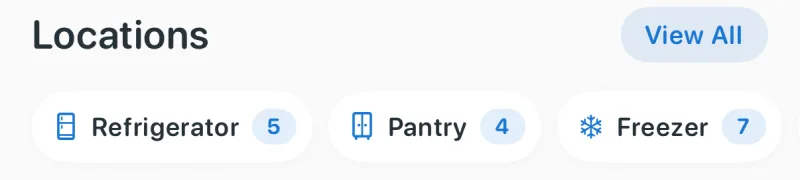
Panzy is a pantry inventory app for iPhone, and Freezer is one of its storage locations, next to the fridge and pantry.
- Add items to the Freezer. Scan the barcode to fill in the product details, or type a name for homemade food, then set the amount and the Freezer location.
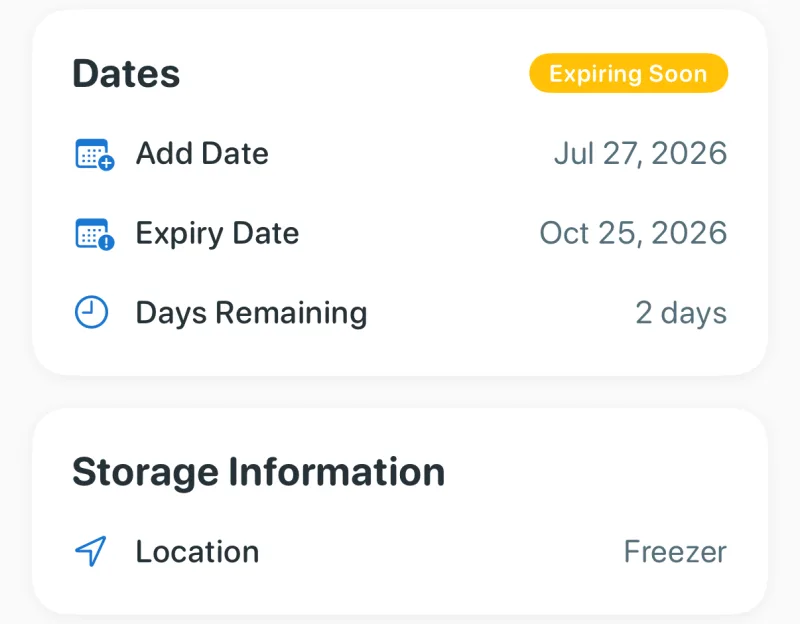
- Use the expiration date as your "use by". Set it to the freezer-chart date (for ground beef, about 4 months from today). The item shows the date you added it next to that date, so you can see how long it has been in there.
- Get a reminder. The item shows as expiring soon as the date gets close, and with Panzy+ you can turn on an expiration reminder for a notification a chosen number of days before.
- Add a note like "leftovers" or "2 portions per bag" in the item's notes.
- See only the freezer. Open the Freezer location, or filter any item list by location, to get your freezer inventory on one screen.
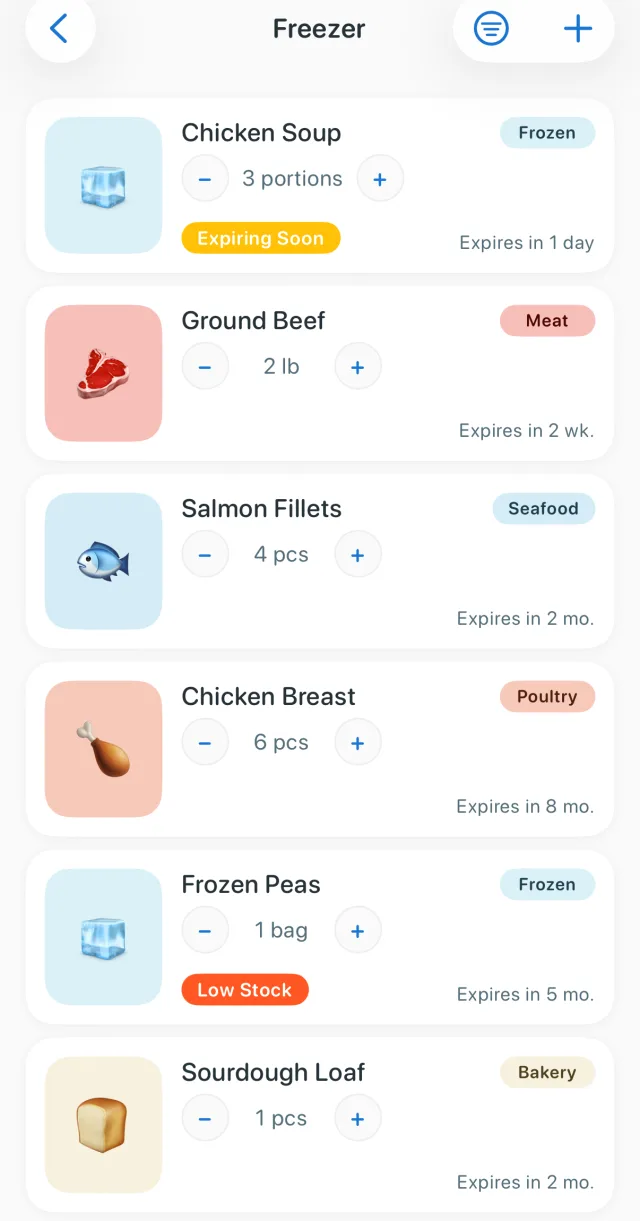
Low-stock levels work in the freezer too. Set one on the frozen vegetables you always want on hand, and they are flagged as Low Stock when you get down to the last bag. With Panzy+, low-stock items go onto your shopping list automatically.
The free version tracks up to 50 items. Panzy+ adds unlimited items, expiration reminders, the automatic shopping list, iCloud sync across your Apple devices, and no ads.
Panzy: pantry tracker
Track what's in your pantry, fridge and freezer, see what is expiring soon, and keep a shopping list that knows what you're low on. Free for up to 50 items.

Common questions
Is frozen food safe to eat after the freezer chart date?
Yes, if it stayed frozen at 0°F (-18°C) the whole time. The USDA says frozen food remains safe indefinitely and the chart times are for quality only. Past the date it may be drier or less flavorful, so it is better in soups, stews or sauces than served on its own.
How often should I update my freezer inventory?
Every time something goes in or comes out, which takes seconds, plus a glance at the "use by" column before each grocery shop. A full recount every few months catches anything that slipped through.
Should I keep a separate inventory for a chest freezer?
If it lives in another room, yes, or at least a separate section on your list. A chest freezer in the garage is where food gets forgotten longest, because you rarely see inside it. Note which bin each item is in.
Can I refreeze meat that has thawed?
If it thawed in the fridge, yes, with some loss of quality. If it thawed on the counter or sat out more than 2 hours (1 hour above 90°F or 32°C), do not refreeze it. Cooking thawed raw meat and then freezing the cooked dish is also safe.